
Austrian Alps: Arnold Schwarzenegger’s Incredible Secret Arm Routine Revealed
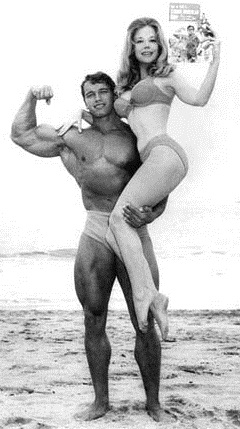
Denizens of any local gym knew that impressive mountain could be found in Venice, California, where there lived and trained an Austrian-born mountain of a man bearing an equally prodigious surname. Even today, many agree that when it comes to biceps development, Arnold Schwarzenegger has never been bettered. Sporting a pair of guns that purportedly stretched the tape to a surreal 22-plus inches, the Austrian Oak shattered previous standards and created a whole new archetype one to which every generation of bodybuilders since has aspired. The Question Remains

To help you chart the course Schwarzenegger took to develop the world’s greatest biceps, we culled information and quotes from the extensive body of work that has appeared in Weider Publications over the years in Arnold’s name. From Tiny Seeds Grow Mighty Oaks
It’s significant (and encouraging) to note that Schwarzenegger wasn’t born with massive guns. In fact, at the time he performed his first bodybuilding workout in 1962, the 15-year-old future Austrian Oak was a mere sapling all six feet and 150 pounds of him. But, he’s quick to point out, “When I was 10 years old, I was already flexing my arms every day. By the time I started bodybuilding at age 15, biceps were the most noticeable muscle group on my body. By flexing my biceps so much, I’d learned to control them more completely.”

See The Biceps, Be The Biceps
Many of us are aware of the mind games Schwarzenegger played in an effort to psych out his opponents come competition time (as illustrated in the film Pumping Iron). However, he didn’t reserve such tactics only for Lou Ferrigno, Franco Columbu or Sergio Oliva. In fact, the person to whom he applied his most intense psychological stratagems was himself.

That being said, Schwarzenegger makes the point that it is important to temper our zeal with a healthy dose of pragmatism. “Enthusiasm is extremely important at all levels of bodybuilding. However, a beginner must learn to be satisfied with small gains overjoyed, in fact. He must not be told that giant gains come easily, that he can get super big overnight as long as he trains like a champion.”

Eye on the prize.

A Shocking Development
As he did with every aspect of his life, Arnold Schwazenneger analyzed exactly what steps would be required for him to build the greatest biceps ever. Although his earliest biceps workouts consisted primarily of barbell and dumbbell curls, as he became exposed to American bodybuilding magazines, he picked up new exercises, such as the preacher curl. By the age of 19, Schwazenneger had already devised a method of training biceps unlike any other one to which his still-developing muscles couldn’t help but respond. “A typical training program would include barbell curls, dumbbell curls (seated or standing), preacher bench curls and concentration curls. Keep in mind, though, that the way I trained changed a lot of times, because I’d always try to shock the muscles,” Schwarzenegger says.


In fact, Schwarzenegger used this seemingly haphazard, yet carefully planned, system of shocking his biceps to stretch the tape measure past the 20″ mark. Interestingly, despite the great success he achieved with this program, he instinctively knew he could create even bigger and, more important, better biceps by making a few alterations to his training system. Fine-Tuning
Ever the perfectionist, the Oak decided to modify what had been a wildly successful biceps routine for him. Whereas previously his sole concern was with packing on beef, now, as a professional competitor, he realized that he’d have to become more discriminating as to how and where he placed it. To this end, he chose to break up his biceps training into two distinct routines: offseason, which comprised the nine months following the Mr. Olympia contest, and precontest, which accounted for the three months leading up to the Olympia.

Off-season Routine
When bulking up, Schwarzenegger would follow a six-day split, hitting arms twice per week. Incredibly, each arm workout would take a full two hours: 45 minutes for triceps, 45 minutes for biceps and 30 minutes for forearms, in that order. “The severity of using absolute maximum poundage for each exercise of this super-bombing routine requires three to four days of rest between arm workouts so that full recuperation and maximum growth occur,” Schwarzenegger instructs.
Exercise 1: Cheating barbell curl
“The cheating barbell curl stands alone for building mass. I start the movement with the barbell at the thighs, with a shoulder-width grip, and nudge it into motion with a slight body movement. This gives me sufficient momentum to pass any sticking points as long as I keep concentrating. I go to full biceps flexion, then lower the bar slowly to the starting position.”

Exercise 2: Incline dumbbell curl
“I lie on a 45-degree incline bench. I prefer the low incline because it permits the biceps to fully extend at the bottom of the movement and remain under this tension during the entire movement upward.” One of the rules of muscle kinetics says that the greater the initial tension on the muscle, the greater the number of contracting fibers during flexion.”

Exercise 3: One-arm concentration curl

Form during this concentration curl movement becomes highly critical. The tendency prevails, even among the most experienced bodybuilders, to draw the elbow in toward the chest during this movement. The elbow must not move from the vertical plane of the curling movement. The upper arm must remain vertical, and the dumbbell must be curled to the shoulder. Although it seems like a restricting uncomfortable movement, it remains the secret to peak biceps development.”
Exercise 4: Standing alternate dumbbell curls

With this movement, you get that famous little burst of muscle that peaks up the outer biceps head and lends the ultimate touch to any kind of biceps pose. So you must remember to twist the hand as you curl, two motions in one. The biceps come into play quite strongly to supinate your hands, as well as to flex the arms. This little twist gave me separation, brachialis development and lower biceps thickness.” That’s Enough
Four exercises, 20-26 sets, 45 minutes a monstrous biceps workout by nearly anyone’s standards. But for Schwarzenegger, it was just enough. “If I did them right, I didn’t need more,” he offers.
Precontest Routine
“Three months before a contest, I would change my arm routine completely,” says the Oak. “My goal now was to zoom in on chiseling in all the cuts and shape possible. I’d cut down on my sets and go to a superset style of training and try to get a maximum pump each workout.” During this period, Schwarzenegger would shift into overdrive, training each entire arm in superset fashion with little or no rest between the supersets. Being that he was now working on a six-day double split (two workouts per day, six days per week), he’d be blasting his arms with this grueling routine three times each week. And you thought his mass-building routine was a bear! But there’s more.

Do As I Say, Not As I Do
The great Boyer Coe once said, “‘Heavy duty’ is the only way to train if you’re Mike or Ray Mentzer.” Steve Michalik burned through many more partners than he could find to keep up with his “intensity or insanity” approach to training. Now, it could be argued that Arnold Schwarzenegger is at least as, if not more, physiologically gifted than any pro ever. His recuperative powers are almost otherworldly and his threshold for pain legendary. So trying to emulate either of these two workouts may not be advisable, or feasible, for even an experienced bodybuilder. But, gifted or not, Schwarzenegger can also be credited with being history’s hardest thinking bodybuilder. Nothing he ever did throughout his bodybuilding career was accidental or haphazard, which means his programs can serve as tried-and-true templates for your own bodybuilding success, regardless of your experience level or development.

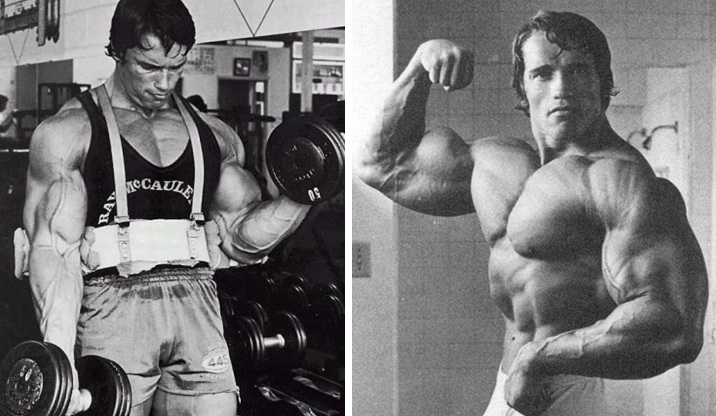
Finally, Schwarzenegger reserves his most surprising bit of advice for advanced trainers. “The biggest post-intermediate-level mistake is to burn the biceps out. Biceps are basically a small muscle group, and you can’t do too much for them without overtraining,” instructs the Terminator of training. So, what constitutes overtraining? “I’d say the upper limit for biceps would be 15 sets in a hard workout, but I see all kinds of bodybuilders doing 25 to 30 sets on a regular basis.”

Hasta La Vista !
Schwarzenegger spilled the beans and gave readers his advice for building massive biceps; now it’s your turn to put his wisdom to use. Put this magazine down, get to the gym and start bombing! Before you do, let the Oak offer you one last bit of wisdom, an axiom regarding muscle growth that spurred him through every workout to ultimate success: “It’s a case of mind over matter. If you’ve got the mind for it, only one thing matters reaching your goal. And you will!” Arnold’s Off-season Bicep Routine

So Alp Me!
- Variety Switch around using barbells, dumbbells and cables.
- Isolation Don’t get help from the delts, lower back or other bodyparts when training biceps. Don’t swing the weight (except during chest curls).
- Full range of motion As this implies, move the weight in a controlled but complete fashion, unless you’re using an intensity movement for a shock session.
- Find the groove Locate the natural line of motion for each movement.
- Total concentration Don’t let your mind wander. Always fixate on the movement and the feeling in the muscle.
Using Arnold’s routine
We feel it’s our solemn duty to let you, our astute readers, know that Arnold Schwarzenegger is a one-in-a-million kind of guy, if not a once-in-a-lifetime phenomenon. “No kidding,” you say. “Why are you telling us something we’ve known since we had muscles worth flexing?” By overstating the painfully obvious, we hope to make the point that as a uniquely gifted athlete, Arnold was capable of doing things in a gym that most mere mortals might find overtaxing if not damn near impossible. Even in advanced athletes, symptoms of overtraining, including chronic fatigue and injury, can result from trying to follow Arnold’s workouts to a T or a T3. That being said, we believe that all bodybuilders young and old, novice and pro can benefit by following the principles presented by Arnold in this article.

If you’re a beginner or an intermediate, perform two or three sets per exercise from his offseason routine, and see how it goes. If you’re an advanced competitive bodybuilder, we recommend that you confine yourself to performing three of the five precontest supersets.


